6
The Storm Model: Beyond "The Moist One"
Most astrology pages will tell you Ardra means "the moist one" or "the teardrop." They will list Rahu as the ruler, Rudra as the deity, and move on. That is surface-level. The deeper truth is that Ardra is not about tears or moisture — it is about the psychological architecture of a soul that must break itself apart to become real.
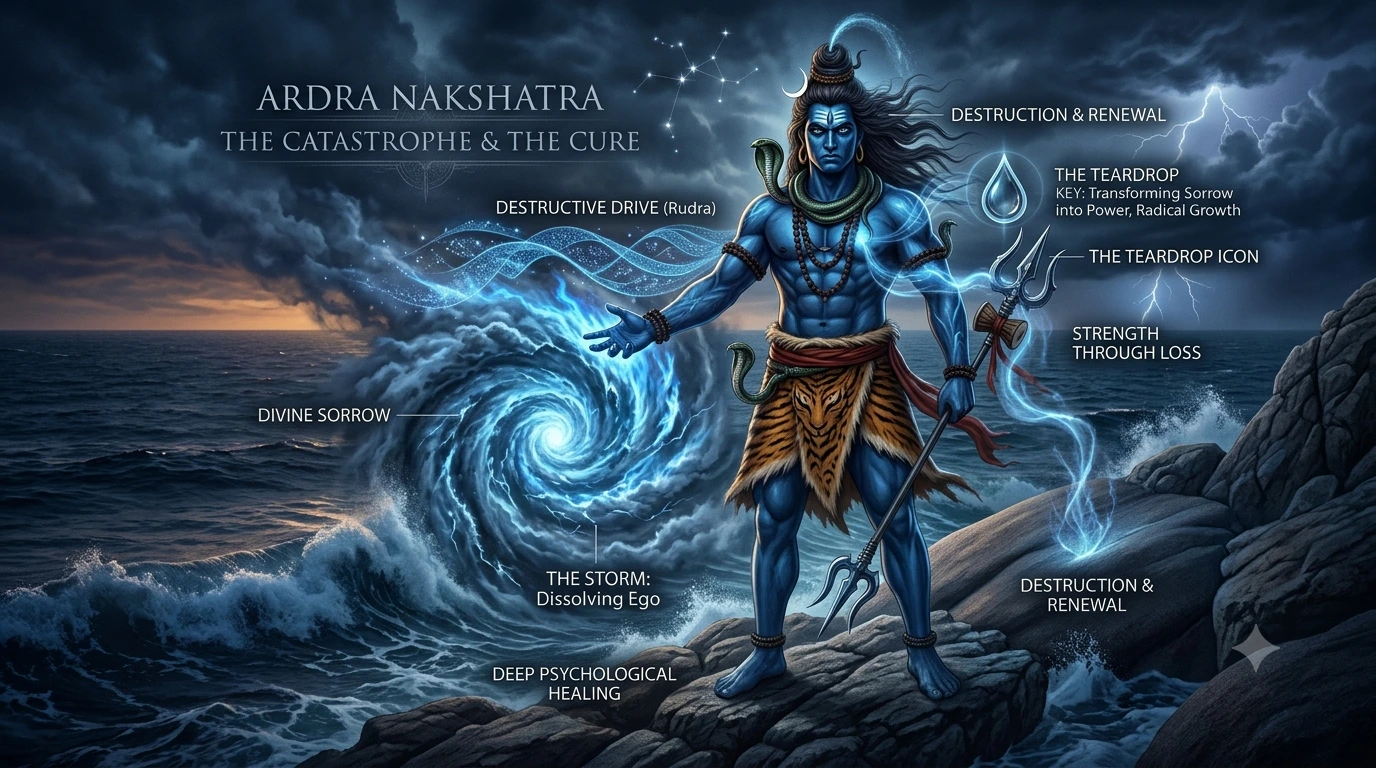
This nakshatra spans 6°40′ to 20°00′ of Gemini . It sits entirely within the sign of duality, communication, and the restless mind. But Rahu rules here — not Mercury. This is the crucial paradox that most interpretations miss. Rahu is the shadow planet of obsession, hunger, and illusion. Mercury is the planet of logic and clarity. The result is a personality that does not just think — it obsesses over truth. Ardra natives do not simply want to know; they want to consume knowledge, to dissolve into it, to be transformed by it.
The Core Insight: Ardra is the nakshatra of transformative dissolution. Its natives are not gentle seekers. They are storms — they destroy old versions of themselves and others to create space for something truer. Their "chaos" is not dysfunction; it is the necessary violence of growth.
The symbol of the teardrop reveals this perfectly. A tear is not just sadness — it is release. It is the body's way of processing what the mind cannot hold. Ardra natives are natural processors of emotional and psychological intensity. They cry, they rage, they break — and in doing so, they clear space for clarity. The deity Rudra, the storm god, is not a punisher; he is a purifier. His storms are not random — they are surgical.
Ardra is a Manushya (human) gana nakshatra . Its wisdom is not meant for solitary transcendence. Every storm you survive is meant to make you more human, not less. The storm is not the enemy of peace — it is the path to it.
The Rahu-Rudra Paradox: Hunger Meets Storm
The central tension of Ardra is the interplay between two forces that seem to oppose each other — Rahu and Rudra. Understanding this paradox is the key to understanding the nakshatra.
Rahu is the north lunar node — the planet of obsession, ambition, and the hunger that never satisfies. It is the force that drives Ardra natives to seek, to strive, to reach beyond their grasp. Rudra is the Vedic storm god — the fierce form of Shiva who destroys what is impure. He is the force that tears down what no longer serves.
When Rahu's hunger meets Rudra's storm, the result is a personality that cannot be satisfied by anything less than total transformation. Ardra natives are not interested in incremental growth. They want to be remade. They want to be destroyed and rebuilt. This is why they often experience dramatic life changes — relationships end, careers shift, identities dissolve. These are not failures. They are the storm doing its work.
The Paradox Resolved: Rahu's hunger is not the problem — it is the fuel. Rudra's storm is not the punishment — it is the purification. The Ardra native who learns to surrender to the storm rather than resist it becomes unstoppable. The one who clings to old identities is destroyed by the very force that was meant to free them.
The Pada Decoder: Four Faces of the Storm
Each pada (quarter) of Ardra reveals a different psychological strategy for navigating transformation. Most pages list the navamsa signs and stop. Here is what each pada actually feels like from the inside:
Pada 1 (6°40′–10°00′) · Sagittarius Navamsa · Syllable: Ku
The Philosophical Storm. Transformation is sought through meaning, truth, and higher knowledge. This pada carries the fire of Sagittarius — these natives destroy old beliefs to find deeper ones. Their shadow: restlessness can become escapism; they may chase spiritual highs instead of doing the work.
Pada 2 (10°00′–13°20′) · Capricorn Navamsa · Syllable: Gha
The Structural Storm. Transformation is achieved through discipline, ambition, and the dismantling of outdated systems. These natives are the ones who rebuild institutions from the rubble. Their shadow: the pursuit of control can become tyranny; they may destroy what they love in the name of efficiency.
Pada 3 (13°20′–16°40′) · Aquarius Navamsa · Syllable: Ang
The Revolutionary Storm. Transformation is sought through collective change, innovation, and the shattering of old paradigms. These natives are the visionaries who see the future and tear down the present to reach it. Their shadow: detachment can become alienation; they may destroy connections in the name of progress.
Pada 4 (16°40′–20°00′) · Pisces Navamsa · Syllable: Chha
The Mystical Storm. Transformation is experienced through dissolution, surrender, and spiritual merging. These natives are the most sensitive — they feel everything and must learn to navigate the emotional floods. Their shadow: escapism and victimhood; they may drown in their own tears if they do not find a container for their depth.
Unique Application: Identify your Moon's exact degree. The pada is not a label — it is a survival strategy for how your particular Ardra energy processes chaos. A Pada 2 native who tries to heal like a Pada 4 (through surrender) will feel weak. A Pada 4 native who tries to heal like a Pada 2 (through control) will feel hollow.
Chaos Alchemy: From Storm to Clarity
Every astrology page mentions Ardra's shadow: restlessness, emotional turbulence, self-destructive tendencies . But what they rarely explain is why this shadow exists, and how to transmute it.
The shadow of Ardra is not a flaw — it is a misdirected search for clarity. The deity Rudra is not a destroyer; he is a revealer. His storms do not create chaos — they expose what was always there, hidden beneath the surface. The Ardra native who clings to drama is a storm that has forgotten it is meant to clear the air, not pollute it.
| Shadow Expression |
Alchemized Power |
| Restlessness — inability to stay still, constant seeking |
Dynamic curiosity — the ability to stay open to life while rooted in purpose |
| Emotional turbulence — cycling through intensity without integration |
Emotional depth — the capacity to feel fully and release cleanly |
| Self-destruction — sabotaging relationships and opportunities |
Sacred disruption — the courage to destroy what no longer serves |
| Obsession — fixating on people, ideas, or outcomes |
Devotion — channeling obsession into a cause larger than the self |
| Victimhood — "bad things always happen to me" |
Resilience — "the storm comes, and I learn to dance in it" |
The alchemical key is water — but not the water of stagnation. The water of Ardra is the rain. Rain is not passive; it falls with purpose. It nourishes, it cleanses, it clears. Every time an Ardra native chooses to release rather than hold, they honor Rudra. Every time they allow themselves to cry instead of suppress, they become clearer. The storm is not the enemy of clarity — it is the method of it.
Storm Wisdom: Living the Nakshatra
Astrology becomes useful only when it translates into daily practice. Here are unique, actionable protocols for Ardra natives that go beyond generic remedies:
-
The Storm Journal: Ardra natives learn through emotional processing. Keep a journal not of events, but of feelings. When the storm rises, write it out. Do not edit. Do not rationalize. Let the rain hit the page. This is Rudra's work.
-
The Release Ritual: Once a week, find a place to be alone. Breathe deeply. Allow yourself to cry if you need to. Do not judge the tears. This is not weakness — it is the storm clearing. Ardra natives who suppress their tears become emotionally constipated.
-
The Obsession Audit: Rahu's hunger is powerful. Once a month, identify one obsession — a person, a goal, a fear — and ask: "Is this serving my growth, or is it consuming me?" If it is consuming, release it. This is the Rahu-Rudra balance.
-
The Wednesday Rahu Reset: Rahu is associated with Wednesday. Wear dark blue or smoky gray. Avoid white. Make an offering of water to a tree or plant. Recite Om Ram Rahave Namah 108 times . This is not superstition — it is a weekly recalibration of your storm energy.
-
The Transformation Tracker: Ardra natives are meant to change. Keep a record of every major identity shift you have experienced. Not the events — the versions of yourself that emerged. This helps you see the storm as a pattern of growth, not a series of disasters.
The Highest Teaching: Ardra is a Manushya (human) gana nakshatra . Its wisdom is not meant for solitary enlightenment. Every storm you survive is meant to make you more human, not less. The Ardra native who has integrated their chaos becomes a safe harbor for others navigating their own storms. The teardrop is not just grief — it is the water that makes the garden grow.
Frequently Asked Questions
What is the true meaning of Ardra?
It translates to "the moist one" or "the teardrop." But its deeper meaning is the psychology of transformative dissolution — the storm that clears the air, the tear that releases what cannot be held, the destruction that makes way for clarity .
Why is Rahu the ruler of a Gemini nakshatra?
This is the central paradox of Ardra. Rahu brings obsession and hunger to Gemini's restless mind. The result is a native who does not just think — they consume knowledge, they obsess over truth, they dissolve into their search .
What does the teardrop symbol mean?
The teardrop represents release, not just sadness. It is the body's way of processing what the mind cannot hold. Ardra natives are natural processors of emotional intensity. The tear is the storm's gift — it clears the heart .
How does one overcome the chaos of this nakshatra?
Through surrender. Rudra's storm is not meant to be resisted — it is meant to be experienced. The practice is to allow the emotions to move through you without clinging to them. Chaos is not the enemy of clarity; it is the path to it .
What careers suit Ardra natives?
Fields that reward intensity, research, and transformation: psychology, therapy, investigative journalism, research science, crisis management, and any role where the ability to navigate chaos is valued .
Ready to Dance in Your Storm?
Your Moon Nakshatra is the key. Get a personalized reading that maps your exact Ardra placement — pada, house, and planetary aspects.
Find Your Nakshatra